SANKING | PLASTIC PIPING CONNECTIONS
Can You Interchange NPT, BSPT, and BSPP?
No. Treat NPT, BSPT, and BSPP as different connections, even when the nominal size matches. Threads that start by hand can still leak or damage a plastic port.
NPT and ISO 7-1 joints seal at the threads with the specified jointing material. BSPP uses a separate seal, such as an O-ring or bonded washer. If the pump or instrument port and valve end differ, specify a rated transition adapter with the thread and seal called out for each end.
Thread comparison / Identify the port / Plastic-to-metal joints / RFQ examples / FAQ
NPT vs BSPT vs BSPP at a Glance
| Thread | Profile and fit | Seal location |
|---|---|---|
| NPT ASME B1.20.1 |
60°. Male and female both taper 1:16 on diameter. | Engaged threads with approved sealant. |
| BSPT ISO 7-1 |
55°. Tapered male R mates with tapered female Rc or parallel female Rp. Tapered threads are 1:16 on diameter. | Engaged threads with the specified jointing material. |
| BSPP ISO 228-1 |
55°. G identifies a parallel male or female thread. | A separate seat or face with the specified O-ring, washer, or gasket. |
Rp and G can both look straight inside a port. An Rp female takes an R tapered male for a thread-sealing joint. A G port needs the mating end and seal geometry shown on its drawing.
ASTM F1498-25 covers dimensions and gaging for 60° tapered threads on thermoplastic pipe and fittings. Confirm applicability to the quoted part and check the assembled joint's service rating separately.
How to Identify a Pump, Instrument, or Valve Port
1. Start with the drawing. Match the part number and revision. Record the thread designation, nominal size, male or female end, and where the joint seals. For a G port, check that the mating part can compress the specified seal before bottoming out.
2. Screen for taper and pitch. On a male fitting, use calipers to compare the outside diameter at two points along the fully formed threads. Use a pitch gauge for threads per inch (TPI). At 1/2 inch, all three thread families have 14 TPI. At 2 inches, NPT has 11.5 TPI and BSPT/BSPP have 11 TPI.
3. Confirm any unknown port before ordering. Calipers and pitch are screening checks. If the drawing is unavailable or ambiguous, have the thread identified using the applicable plug or ring gauge and gaging procedure.
 |
SANKING PVC True Union Ball Valve For a threaded configuration, check the pipe-side end connector. The union nut thread and the body seal are separate interfaces. |
Still choosing the end connection? Compare socket, threaded, and flanged plastic ball valves based on the equipment layout and maintenance access.
Connecting Plastic Valves and Fittings to Metal
Check the material pairing. A tapered metal male can wedge open a plastic female port. Verify that the exact fitting is approved for the pairing. Specify a reinforced connection or rated transition adapter where the manufacturer requires one.
Check the sealant and tightening instructions. Use PTFE tape or paste only where approved for the part, medium, and temperature. Excess tape adds stress, and incompatible compounds can crack PVC or CPVC. Use the tightening instructions for the exact joint.
Keep equipment loads off the port. Align the connection before assembly. Support pipes and heavy accessories independently, and allow for pump vibration and thermal movement.
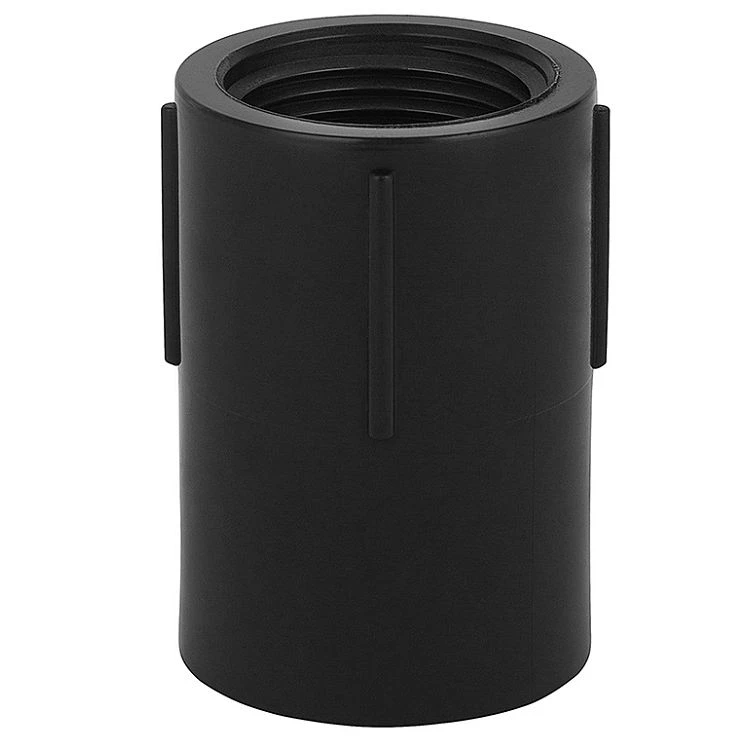 |
Use the drawing to confirm the female thread standard and check whether the exact part is approved for the mating material. |
If the port needs a separate transition, review the plastic fittings range and check the two end callouts before selecting a part.
What to Check When a Threaded Joint Leaks
Isolate and depressurize the line before inspecting or reworking the joint.
Threads bind early. Check pitch, profile, alignment, and cross-threading before applying more force.
A BSPP joint weeps at the face. Check the seal, the seat, and whether the fitting bottoms out before compressing the seal.
The plastic female port shows whitening or a crack. Check for wedging, overtightening, excess tape, or side load. Replace a cracked part and correct the cause.
The joint leaks only in service. Check pipe strain, vibration, and thermal movement before tightening again.
How to Specify Pipe Threads on an RFQ
List End A and End B separately. Include the mating-part drawing revision, fluid, operating pressure and temperature, and quantity. Use callouts like these on the RFQ line item.
NPT valve end
1/2-14 NPT female per ASME B1.20.1. Mates with 1/2-14 NPT male. Confirm the approved thread sealant and material pairing.
ISO 7-1 fitting
Rc 2 female taper to R 2 male taper. Use the jointing material specified for the connection.
BSPP instrument port
G 1/2 female per ISO 228-1. Quote a matching male adapter with a bonded washer and shoulder per the port drawing.
For a valve RFQ, include the model from the SANKING plastic ball valve range along with the exact end-connector callout.
Send Your Mating-Port Drawing to SANKING
Send the thread designation, male/female connection, mating-part drawing, and sealing method before quotation.
Pipe Thread Compatibility FAQ
Can a 1/2-inch NPT male fit a 1/2-inch BSPT plastic valve?
Use a rated adapter between them. Both have 14 TPI, so the fitting may start, but the 60° and 55° profiles engage differently.
Can I connect an R male to a G female port?
Use an adapter that matches both ends and provides the required seal. The R end belongs in an ISO 7-1 Rc or Rp connection. The G port requires its own sealing surface.
Does a BSPP fitting always use an O-ring?
Check the drawing. A BSPP connection can use an O-ring, bonded washer, or face gasket, depending on the end design.
Can PTFE tape stop a BSPP face leak?
No. Check the seal for damage and verify that it seats and compresses as the drawing specifies.
Can I reuse the threaded ends on a replacement true union ball valve?
Confirm the valve series, connector geometry, union nut, and body seal against the replacement drawing. Matching pipe threads alone cannot establish union compatibility.
What if the pump drawing says only "1/2 BSP"?
Ask for the exact designation. Send the pump model, port photos, and a close-up of the sealing face. Clarify catalog labels such as "PT" or "BSPF" the same way.
Standards and Identification References
ASME B1.20.1 · ISO 7-1 · ISO 228-1 · ASTM F1498-25
Swagelok Thread and End Connection Identification Guide · IPEX Vinyl Process Piping Technical Manual