Select the exact pipe size before relying on the Schedule number
ASTM D1785 covers PVC pressure pipe in Schedules 40, 80, and 120. Schedule is a wall-thickness series, not one fixed pressure rating. For the same IPS nominal size, Schedule 40 and Schedule 80 pipe use the same outside diameter, but Schedule 80 has a thicker wall and a smaller inside diameter. Check the pressure rating for the exact pipe size, then review operating temperature, surge pressure, fluid compatibility, fittings, valves, and connection standards before approval.
What ASTM D1785 Covers

ASTM D1785 specifies PVC plastic pipe made in Schedule 40, Schedule 80, and Schedule 120 dimensions. The pipe is pressure-rated for water and intended for pressurized liquids that are chemically compatible with the piping material.
The standard covers material classification, dimensions, workmanship, sustained pressure, burst pressure, flattening, extrusion quality, appearance, and pipe marking. It provides a basis for specifying and inspecting the pipe itself.
ASTM D1785 applies to pipe, not the complete piping system
A pipe marked ASTM D1785 does not automatically qualify the fittings, valves, solvent-cement joints, threaded joints, flanges, seals, or assembled system. Each component must be checked against its own standard, dimensions, pressure-temperature rating, chemical limits, and installation requirements.
SANKING Schedule 40 and Schedule 80 PVC Pipe Dimensions

D is the pipe outside diameter.
T is the minimum wall thickness.
The outside-diameter tolerance is shown as a plus-or-minus value.
| Nominal | Socket Type | |||||
| SIZE | D(MM) | Tolerance | SCH80 | SCH40 | ||
| T(min/mm) | Tolerance | T(min/mm) | Tolerance | |||
| 1/2" | 21.34 | ±0.10 | 3.73 | +0.51 | 2.77 | +0.51 |
| 3/4" | 26.67 | ±0.10 | 3.91 | +0.51 | 2.87 | +0.51 |
| 1" | 33.40 | ±0.13 | 4.55 | +0.53 | 3.38 | +0.51 |
| 1¼" | 42.16 | ±0.13 | 4.85 | +0.58 | 3.56 | +0.51 |
| 1½" | 48.26 | ±0.15 | 5.08 | +0.61 | 3.68 | +0.51 |
| 2" | 60.32 | ±0.15 | 5.54 | +0.66 | 3.91 | +0.51 |
| 2½" | 73.02 | ±0.18 | 7.01 | +0.84 | 5.16 | +0.61 |
| 3" | 88.90 | ±0.20 | 7.62 | +0.91 | 5.49 | +0.66 |
| 4" | 114.30 | ±0.23 | 8.56 | +1.02 | 6.02 | +0.71 |
| 5" | 141.30 | ±0.25 | 9.52 | +1.14 | 6.55 | +0.79 |
| 6" | 168.28 | ±0.28 | 10.97 | +1.32 | 7.11 | +0.86 |
| 8" | 219.08 | ±0.38 | 12.70 | +1.52 | 8.18 | +0.99 |
| 10" | 273.50 | ±0.38 | 15.06 | +1.80 | 9.27 | +1.12 |
| 12" | 323.85 | ±0.38 | 17.45 | +2.08 | 10.31 | +1.24 |
| 14" | 355.60 | ±0.38 | 19.05 | +2.28 | 11.10 | +1.35 |
Source: SANKING PVC pipe dimension sheet supplied for this page. Confirm the approved drawing and purchase specification before production or inspection.
What this table does not provide
This is a dimensional table, not a pressure-rating table. It does not provide operating pressure, temperature derating factors, chemical compatibility, or Schedule 120 dimensions. Request the applicable SANKING pressure-temperature data and confirm Schedule 120 availability separately.
Do not use minimum wall thickness as the final inside diameter for hydraulic calculations. Actual wall thickness may be greater within the stated tolerance. Use the approved product drawing or measured bore when the flow area is critical.
View the available SANKING plastic pipe range before fixing the size, Schedule, quantity, or project documentation.
Schedule 40 vs. Schedule 80 vs. Schedule 120
| Schedule | Direct comparison | What to check before ordering |
|---|---|---|
| Schedule 40 | Thinner wall and larger bore than Schedule 80 pipe of the same IPS nominal size. | Exact size pressure rating, actual temperature, surge pressure, supports, joint method, and matching fittings. |
| Schedule 80 | Thicker wall and smaller bore than Schedule 40 pipe of the same IPS nominal size. | Reduced flow area, pressure loss, fitting standard, valve connection, temperature derating, and fluid compatibility. |
| Schedule 120 | A heavier wall series available only in the sizes covered by the applicable product range. | Actual availability, size-specific rating, smaller bore, fittings and valves, joint design, cost, and whether PVC remains suitable for the service. |
A higher Schedule does not solve every application problem. Moving from Schedule 40 to Schedule 80 or 120 increases wall thickness, but it does not confirm chemical resistance, temperature suitability, joint quality, or the rating of the fittings and valves.
Why Schedule Is Not One Pressure Rating
The Schedule number describes a dimensional series. The allowable pressure must be checked for the exact nominal size and the specific pipe product.
A larger pipe in the same Schedule does not automatically carry the same pressure rating as a smaller pipe. The final system pressure also depends on temperature, service life assumptions, surge conditions, joint design, and the ratings of the connected components.
A purchase order that states only "Schedule 80 PVC pipe" is incomplete. It should identify:
- Nominal pipe size and IPS dimensional system
- Required Schedule
- Applicable ASTM edition required by the project
- Working and surge pressure
- Normal and maximum temperature
- Fluid name and concentration
- Required markings and documents
Check Pressure at the Actual Operating Temperature
Use the pressure rating for the exact size and Schedule shown on the applicable SANKING product data. Then compare the table's reference temperature with the real operating condition.
When the pipe operates above the reference temperature, apply the manufacturer's temperature derating data. Do not copy a derating factor from an unrelated pipe supplier without confirming the compound, product construction, and rating basis.
The review must include more than normal pump discharge pressure:
- Continuous operating pressure
- Pump shutoff pressure
- Water hammer and valve-closing surge
- Normal liquid temperature
- Maximum process or cleaning temperature
- Fitting, valve, union, flange, seal, and joint ratings
The allowable system pressure cannot exceed the rating of its lowest-rated component under the actual operating temperature. A Schedule 80 pipe does not increase the rating of a lower-rated valve, fitting, union, or joint.
Do not assume pneumatic testing is permitted
Compressed air and other compressed gases store substantially more energy than a liquid-filled test system. Follow the written test procedure supplied by the pipe, fitting, and valve manufacturers and the project safety requirements before pressure testing.
Matching ASTM D1785 Pipe With PVC Fittings
ASTM D1785 controls the pipe. PVC pressure fittings are covered by separate product standards. Schedule 40 socket fittings are commonly specified to ASTM D2466, Schedule 80 socket fittings to ASTM D2467, and Schedule 80 threaded fittings to ASTM D2464.
Can Schedule 40 pipe connect to a Schedule 80 socket fitting? Dimensionally, it can often be joined when both products use compatible PVC IPS solvent-cement socket dimensions. That does not make every Schedule 40 and Schedule 80 combination automatically acceptable.
Before approving the connection, confirm:
- PVC material and compound requirements
- IPS outside diameter
- Socket diameter and insertion depth
- Fitting product standard
- Solvent cement and primer requirements
- Joint preparation, cure time, temperature, and humidity
- Pressure-temperature rating of the completed joint
Installing a Schedule 80 fitting does not raise the rating of Schedule 40 pipe. The completed line remains limited by the lowest-rated pipe, fitting, valve, seal, flange, or joint.
Review the available SANKING plastic fittings together with the pipe rather than approving them as unrelated purchase items.
Matching the Pipe With PVC Valves
A valve marked 2 inches or DN50 is not automatically compatible with every pipe carrying a similar nominal size. Confirm the dimensional system and the complete valve end connection.
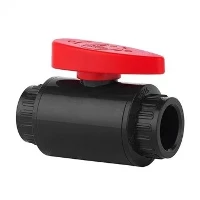
For a PVC ball valve, the RFQ should identify:
- Nominal size and pipe outside diameter
- Socket, threaded, true-union, or flanged connection
- IPS, DIN, JIS, CNS, ANSI, or another dimensional standard
- NPT, BSP, PT, or another thread form where applicable
- Valve pressure rating at the actual temperature
- PVC body and wetted-component materials
- EPDM, FKM, or another seal material
- Manual, pneumatic, or electric operation
Use the socket, threaded, and flanged plastic valve guide when the drawing lists only a nominal size or does not clearly identify the valve end standard.
Chemical Compatibility Must Be Checked Separately
ASTM D1785 does not state that PVC is suitable for every acid, alkali, oxidizer, solvent, cleaning chemical, or process liquid. The standard applies to pressurized liquids that are chemically compatible with the piping material.
A useful compatibility review requires the actual service information:
- Full chemical name or formulation
- Concentration
- Normal and maximum temperature
- Continuous, intermittent, or cleaning exposure
- Working and surge pressure
- Additives, solvents, oils, or suspended solids
Check the pipe, valve body, ball, seats, O-rings, solvent cement, gasket, and every other wetted material separately. A compatible PVC pipe does not prove that the valve seal or joining material is compatible.
When PVC is close to the required temperature or chemical limit, compare PVC with CPVC, PPH, or PVDF instead of increasing the Schedule alone. The PVC, CPVC, PPH, and PVDF selection matrix provides a practical starting point.
Typical Project Checks
| Application | Check first | Frequent selection mistake |
|---|---|---|
| Industrial water treatment | Dosing chemicals, cleaning temperature, pump pressure, valve seals, and maintenance access. | Checking only the main water line and ignoring the dosing or cleaning chemicals. |
| Filtration and OEM skids | Available space, flow loss, union valves, equipment ports, and repeatable BOM specifications. | Changing from Schedule 40 to Schedule 80 without checking the smaller bore. |
| Irrigation systems | Pump shutoff pressure, water hammer, exposed or buried installation, supports, and fitting availability. | Selecting from normal operating pressure while ignoring transient pressure. |
| Pump rooms | Metal-to-plastic transitions, flange drilling, vibration, supports, valve removal space, and surge conditions. | Ordering pipe and valves by nominal size without checking the connection standard. |
| General pressure water lines | Exact size, pressure, temperature, joint method, project code, and required approvals. | Treating ASTM D1785 as automatic approval for potable water, local codes, or the complete system. |
Check Pipe Marking and Documents Before Installation
Compare the pipe marking with the purchase order, approved data sheet, packing list, and project submittal before cutting or joining the pipe.
Check the standard designation, nominal size, Schedule, material identification, manufacturer or brand, and available traceability information. Pipe color alone is not proof of material, Schedule, pressure rating, or ASTM conformity.
For the quoted product range, SANKING can provide:
- Available pipe sizes and Schedules
- Outside-diameter and wall-thickness data
- Applicable pressure-temperature information
- Pipe marking photographs
- Matching fitting and valve options
- Connection-standard information
- Available product data sheets and drawings
Document availability must be confirmed for the exact size and product being quoted. A document issued for one pipe range, compound, size, or production lot should not be used as proof for a different item.
Information Required for Pipe, Fitting, and Valve Matching
Include the following information in the RFQ:
- Nominal pipe size
- Schedule 40, 80, or 120
- Required quantity and pipe length
- Continuous working pressure
- Maximum or surge pressure
- Normal and maximum temperature
- Liquid name and concentration
- Socket, threaded, true-union, or flanged connection
- IPS, ANSI, DIN, JIS, CNS, NPT, BSP, or another required standard
- Required fittings, valves, seals, drawings, markings, and inspection documents
Match the Complete Connection Before Ordering
Send your pipe size, Schedule, operating temperature, working and surge pressure, fluid, and connection standard. SANKING will check the available pipe dimensions and the corresponding fitting and valve interfaces before quotation.
Send Your Pipe RequirementsASTM D1785 PVC Pipe FAQ
Does ASTM D1785 cover PVC fittings and valves?
No. ASTM D1785 applies to PVC pipe. Fittings, valves, joints, flanges, and seals must be checked against their own standards, dimensions, materials, and pressure-temperature ratings.
Is Schedule 80 always rated for more pressure than Schedule 40?
For the same nominal size and comparable PVC pipe product, Schedule 80 normally has a thicker wall and a higher pipe pressure rating. The exact rating still depends on pipe size, temperature, material classification, and the product data.
Does the same nominal size guarantee that the pipe and valve will fit?
No. Confirm the actual pipe outside diameter, dimensional system, and valve end connection. IPS, DIN, JIS, CNS, socket, thread, and flange dimensions are not interchangeable simply because the nominal sizes look similar.
Can Schedule 40 pipe be joined to a Schedule 80 socket fitting?
It is often dimensionally possible when both products use compatible PVC IPS solvent-cement socket dimensions. Confirm the product standards, material, socket dimensions, joining procedure, and pressure-temperature rating before approval.
Why is Schedule 120 not shown in the SANKING dimension table?
The supplied dimension sheet lists Schedule 40 and Schedule 80 pipe from 1/2 inch through 14 inches. Schedule 120 sizes and availability must be confirmed separately for the requested project.
Does ASTM D1785 confirm chemical compatibility?
No. Confirm the chemical name, concentration, temperature, pressure, exposure pattern, and every wetted material. The pipe, valve, seal, fitting, and solvent cement may have different compatibility limits.
What should be included in a PVC pipe RFQ?
Provide the pipe size, Schedule, quantity, length, working and surge pressure, normal and maximum temperature, fluid and concentration, connection standard, required fittings and valves, and document requirements.
Standard status reviewed: July 20, 2026.
ASTM D1785-21a was listed by ASTM as the active edition at the time of review. ASTM WK98245 was listed as a proposed revision, not a published replacement.
Official reference: ASTM D1785-21a.
Check the current ASTM edition and the edition specified by the project before publication, tender submission, purchase, production, or compliance review.