Material Composition and Fundamentals
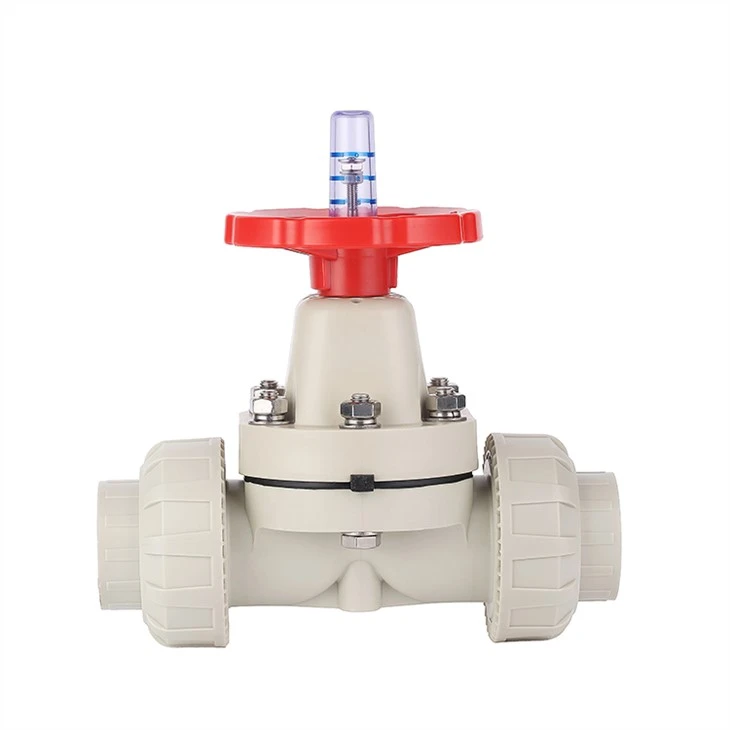
PPH (Polypropylene Homopolymer) is a semi-crystalline thermoplastic polymer derived from propylene monomers. Its molecular structure-characterized by strong carbon-carbon (C-C) and carbon-hydrogen (C-H) bonds-provides inherent chemical stability. Compared to other thermoplastics like PVC or PE, PPH offers:
- Higher melting point (~160–170°C), enabling use in moderately high-temperature applications.
- Improved mechanical strength (stiffness) compared to soft plastics like LDPE.
- A non-polar structure, making it resistant to most aqueous solutions, acids, alkalis, and organic solvents.
Key Corrosion Resistance Advantages of PPH Diaphragm Valves
(1) Resistance to Acids and Alkalis
-
Acids: PPH performs excellently in dilute to moderately concentrated acids (e.g., sulfuric acid <60%, hydrochloric acid <35%, nitric acid <40%) at room temperature. Even at elevated temperatures (up to ~80°C), degradation is minimal for non-oxidizing acids.
Exception: Strong oxidizing acids (e.g., concentrated nitric acid >60% or chromic acid) may gradually degrade PPH over prolonged exposure due to chain scission. -
Alkalis: Highly resistant to hydroxides (e.g., sodium hydroxide, potassium hydroxide) at all concentrations, even at elevated temperatures. PPH's non-polar structure is unaffected by polar alkaline solutions.
(2) Resistance to Salts and Aqueous Solutions
-
PPH is inert to most salt solutions (e.g., sodium chloride, magnesium sulfate), making it suitable for applications in seawater, brine systems, or chemical processing involving ionic compounds.
-
Corrosion from neutral salts (e.g., sodium sulfate) is negligible, as PPH does not ionize or react with dissolved ions.
(3) Resistance to Organic Compounds
-
Non-Polar Solvents: PPH shows good resistance to non-polar organic solvents like hydrocarbons (e.g., gasoline, toluene) and alcohols (e.g., ethanol, methanol) at room temperature.
Limit: Prolonged immersion in high-concentration solvents (e.g., benzene, chloroform) may cause swelling or softening due to partial molecular dissolution. -
Polar Solvents: Moderate resistance to polar solvents like ketones (e.g., acetone) or esters, but performance depends on temperature and exposure duration.
(4) Resistance to Oxidizing Agents
-
PPH has limited tolerance for strong oxidizers (e.g., hydrogen peroxide, chlorine dioxide). While it resists mild oxidizing environments (e.g., chlorinated water at low concentrations), prolonged contact with high-strength oxidants can lead to chain oxidation and embrittlement.
-
Mitigation: Adding stabilizers (e.g., antioxidants) during PPH compounding can improve resistance to oxidative degradation.
Limitations and Failure Modes
(1) Temperature-Dependent Corrosion Risks
-
High Temperatures: As temperature approaches PPH's melting point (~160°C), its chemical resistance declines. For example, in concentrated sulfuric acid at >90°C, PPH may undergo thermal-oxidative degradation.
-
Cold Brittleness: Below ~0°C, PPH becomes brittle, increasing susceptibility to stress cracking (though this is a mechanical rather than chemical failure mode).
(2) Mechanical-Chemical Interactions
-
Stress Corrosion Cracking (SCC): Under sustained mechanical stress (e.g., improper installation, pressure surges), PPH may crack when exposed to certain chemicals (e.g., halogenated hydrocarbons like carbon tetrachloride).
-
Abrasion-Erosion: In slurries or particulate-laden fluids, mechanical abrasion can thin the diaphragm or valve body, indirectly accelerating chemical penetration.
(3) Environmental Factors
-
UV Exposure: Unprotected PPH degrades under prolonged ultraviolet (UV) radiation, leading to surface embrittlement and loss of corrosion resistance. Always use UV-stabilized PPH grades for outdoor applications.
-
Chlorine Exposure: While PPH resists low-concentration chlorinated water, high-dose chlorination (e.g., >100 ppm in wastewater treatment) may gradually oxidize the polymer surface.