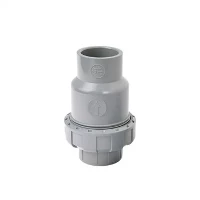
Check valves play a critical role in many industrial and civil scenarios. They can effectively control the one-way flow of fluids and avoid various problems caused by medium backflow. The following are some situations where check valves should be installed:
Prevent backflow in fluid delivery systems
1. At the outlet of the water pump
- When the water pump stops working, if there is no check valve, water will flow back to the water pump under the action of gravity, which may cause the impeller of the water pump to reverse. This will not only damage the mechanical parts of the water pump, such as shafts and bearings, but also may cause the next time the water pump is started, it may not start normally due to the reversal of the impeller or require a greater torque to start.
- For example, in the water supply system of a building, a check valve installed at the outlet of the water pump can ensure that when the water pump stops running, water will not flow back into the water pump, thereby protecting the water pump equipment and maintaining the normal pressure of the pipeline system.

2. At the outlet of the lifting equipment
- For delivery systems such as lifting crude oil and chemical liquids, installing a check valve at the outlet of the lifting pump can prevent liquid backflow. For example, in an oil refinery, crude oil is pumped from a storage tank to a high-level reactor. If there is no check valve, when the pump stops working, the crude oil in the reactor may flow back to the storage tank, which may cause the production process to be interrupted and may have an impact on the pipeline system.
Prevent different media from mixing with each other
1. In a heat exchange system
- When a heat exchanger is used to heat or cool a certain medium, such as in a heat exchanger system that uses steam to heat water, a check valve is installed at the entrance of the steam pipe into the heat exchanger. When the steam supply is interrupted or the pressure drops, the check valve can prevent the heated water from flowing back into the steam pipe, avoiding mutual contamination of the water and steam systems.
2. Between different reaction material pipelines in chemical production
- During the chemical production process, different chemicals may enter the reactor through different pipelines. Installing a check valve on the feed pipeline of each reactant can prevent the reactants from mixing with each other. For example, in the process of producing sulfuric acid, the pipelines used to transport sulfur dioxide and oxygen are respectively installed with a check valve before entering the converter, which can prevent one gas from flowing back into the pipeline of another gas and avoid unexpected chemical reactions.
Environmental protection and safety considerations
1. In sewage treatment systems
- Installing a check valve on the outlet pipe of a sewage lifting pump station can prevent sewage from flowing back to residential areas or natural water bodies when the pump station fails or stops operating. For example, in the sewage discharge system of coastal cities, when heavy rain causes the water level in the drainage pipe to be too high, the sewage lifting pump station may work at full capacity. Without a check valve, sewage may flow back into the city's rainwater drainage system, thereby polluting surrounding rivers, oceans and other natural water bodies.
2. In fire protection systems
- Installing a check valve on the pipe of the fire pump connector is to prevent fire water from flowing back from the fire pipe network into the water supply system of the fire truck in non-firefighting situations, or water backflow between different fire zones, to ensure that fire water can be accurately supplied to the fire scene when needed, while avoiding waste and cross-contamination of fire water.